Honor Killings in the Twenty-First Century by Nicole Pope
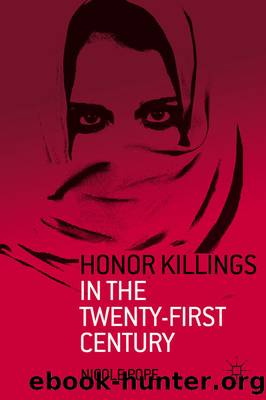
Author:Nicole Pope
Language: eng
Format: epub
Publisher: Palgrave Macmillan
CHAPTER 11
BERFINâ
I met Berfin at a conference on honor killings organized by the Swedish government outside Stockholm, where she had come to testify about her extraordinary ordeal. She was accompanied by Dr. Nazand Begikhani, a London-based Kurdish rights activist, who had played an important role in her rescue.
Nothing in Berfinâs demeanor or in her fresh face, free of makeup, betrayed the long ordeal that she had experienced. At 37, she had the lithe body of a young girl and thick light-brown hair that made her look years younger than she really was. She spoke in a low voice, and only the intensity of her tone and the nervous movements of her fingers gave a hint of her inner turmoil.
Berfin was a Kurd from northern Iraq, a region that has experienced much upheaval in the past few decades. Kurds do not have their own country: they are divided between Iraq, Iran, Turkey, and Syria, and they have all experienced oppression to varying degrees over the years in their respective areas. Iraqâs dictator Saddam Hussein waged a ruthless war against Kurdish resistance fighters, known as peshmergas (literally those who defy death), who were seeking more autonomy from the Baghdad government. Kurdish civilians too were targeted.
A vicious military campaign known as Anfal (the word means spoils of war, and comes from a verse in the Koran) led to the destruction of some 4,000 villages and claimed 100,000 to 150,000 victims, mostly male, between 1986 and 1988. It culminated in the gassing of Kurdish civilians in the town of Halabja in March 1988, which killed up to 5,000 town residents and injured thousands more.
Although it is in a process of rapid transformation, Kurdish society remains very tribal. The U.S. invasion in 2003 and subsequent occupation did not cause as much unrest in the north of Iraq as it did in the rest of the country. In fact, Iraqi Kurds were able, to a large extent, to consolidate their quasi-autonomous status.
The two main Kurdish political factionsâthe Kurdistan Democratic Party (KDP), led by Masoud Barzani, and the Patriotic Union of Kurdistan (PUK), founded by Jalal Talabani, who is now Iraqâs presidentâhave acted in concert in the past few years and the Kurdish enclave in northern Iraq has been relatively peaceful. But as recently as in the 1990s, their rivalry triggered lethal clashes.
Against this backdrop of violence, Kurdish women have been trying to gain more autonomy for themselves. Activists have become more vocal in their demands, but honor killings and other forms of gender violence, including female circumcision, are still rife in this patriarchal region.
Like many girls growing up in Iraqi Kurdistan, Berfin was expected to submit to her male relativesâ will and accept the fate that they had chosen for her. âI have been oppressed since the age of six,â she said, stating a simple fact. âMy father had banished my mother and her four children, including myself, and remarried. It was only when I reached fifteen that I realized how bad he was.â
Berfin had little
Download
This site does not store any files on its server. We only index and link to content provided by other sites. Please contact the content providers to delete copyright contents if any and email us, we'll remove relevant links or contents immediately.
| Anthropology | Archaeology |
| Philosophy | Politics & Government |
| Social Sciences | Sociology |
| Women's Studies |
Cecilia; Or, Memoirs of an Heiress — Volume 1 by Fanny Burney(32558)
The Great Music City by Andrea Baker(32018)
Cecilia; Or, Memoirs of an Heiress — Volume 2 by Fanny Burney(31956)
Cecilia; Or, Memoirs of an Heiress — Volume 3 by Fanny Burney(31941)
We're Going to Need More Wine by Gabrielle Union(19046)
All the Missing Girls by Megan Miranda(16023)
Pimp by Iceberg Slim(14506)
For the Love of Europe by Rick Steves(14121)
Bombshells: Glamour Girls of a Lifetime by Sullivan Steve(14073)
Talking to Strangers by Malcolm Gladwell(13370)
Norse Mythology by Gaiman Neil(13363)
Fifty Shades Freed by E L James(13239)
Mindhunter: Inside the FBI's Elite Serial Crime Unit by John E. Douglas & Mark Olshaker(9339)
Crazy Rich Asians by Kevin Kwan(9290)
The Lost Art of Listening by Michael P. Nichols(7506)
Enlightenment Now: The Case for Reason, Science, Humanism, and Progress by Steven Pinker(7311)
The Four Agreements by Don Miguel Ruiz(6763)
Bad Blood by John Carreyrou(6621)
Weapons of Math Destruction by Cathy O'Neil(6279)
